
How Long Can a Debt Collector Legally Pursue Old Debt? | Paralegal Guides
How Long Can a Debt Collector Legally Pursue Old Debt? Debt doesn't follow you forever. Learn how the statute of limitations works by state and debt type, what restarts the clock, and exactly what your rights are under the FDCPA.
5/25/202611 min read
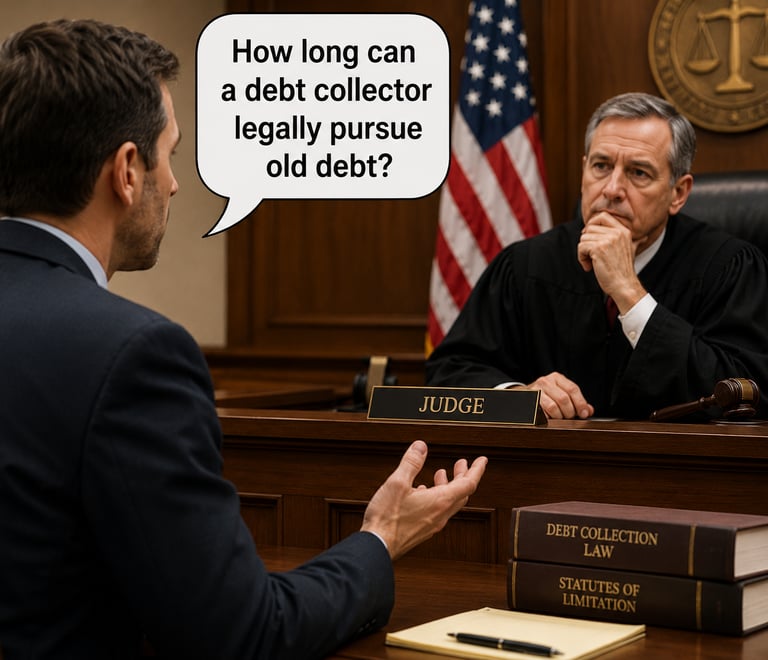
How Long Can a Debt Collector Legally Pursue Old Debt?
By A Paralegal's Guide to Credit Repair | paralegalguides.com
Picture this.
It's been years since that credit card went delinquent. Years since you heard from anyone about it. You've moved on, rebuilt your life, and honestly — you'd almost forgotten it existed.
Then the phone rings. Or a letter shows up. And suddenly someone is telling you that you owe money. A lot of it. And they want it now.
Your stomach drops. Your mind races. And the first question that forms — the one you absolutely need to know the answer to before you do anything else — is this:
Can they actually still come after me for this?
The answer depends on something called the statute of limitations on debt. And understanding it — really understanding it, not just the surface-level version — could be the difference between paying a debt you no longer legally owe and protecting yourself with confidence.
That's exactly what this post is about. We're going to cover how long debt collectors can legally pursue old debt, how the clock works, what resets it, what never resets it, what collectors are and aren't allowed to do on old debt, and how this all connects to your credit report.
By the end of this, you'll know exactly where you stand.
What Is the Statute of Limitations on Debt?
The statute of limitations on debt is the legal time window during which a creditor or debt collector can sue you in court to collect a debt. Once that window closes, the debt is considered "time-barred" — meaning the collector loses the legal right to obtain a court judgment against you for it.
Let's be clear about what this means and — just as importantly — what it doesn't mean.
What it means: After the statute of limitations expires, a collector cannot successfully sue you for the debt. If they try, you can raise the expired statute of limitations as a defense, and the case should be dismissed.
What it doesn't mean: The debt doesn't disappear. You still technically owe it in a moral sense. The collector can still contact you and ask you to pay. The debt can still appear on your credit report (until the separate credit reporting time limit expires). The statute of limitations is purely a legal defense against a lawsuit — not a magic eraser.
This distinction matters enormously, and we'll come back to it.
How Long Is the Statute of Limitations — By Debt Type?
Here's where it gets specific — and where most people get confused, because the statute of limitations varies by state and by type of debt. There is no single federal answer.
Most states set their statute of limitations somewhere between 3 and 10 years, depending on the category of debt. The four main categories are:
Written contracts: Debts based on a signed written agreement — personal loans, most credit cards with a signed agreement, medical debt. Most states give these 4 to 6 years, though some go as high as 10.
Oral contracts: Debts based on a verbal agreement with no written documentation. These typically have shorter statutes — often 3 to 4 years.
Promissory notes: Written promises to repay a specific amount by a specific date — student loans, some personal loans. Statutes typically range from 3 to 6 years.
Open-ended accounts: Revolving credit like credit cards and lines of credit. Most states treat these similarly to written contracts — 4 to 6 years — though some states have specific rules for open-ended accounts.
A few important state-specific examples (these can change, so always verify current law in your state):
California: 4 years for written contracts
Texas: 4 years for most debt
New York: 3 years (reduced from 6 in 2021)
Florida: 5 years for written contracts
Illinois: 5 years for written contracts
Ohio: 6 years for written contracts
Michigan: 6 years for written contracts
Georgia: 6 years for written contracts
Federal student loans are a different matter entirely. There is no statute of limitations on federal student loan debt. The federal government can pursue collection indefinitely. Private student loans, however, are subject to state statutes of limitations like other private debts.
Because statutes of limitations vary so significantly by state — and because states do occasionally update their laws — always verify the current statute of limitations in your specific state before making any decisions based on it. Your state attorney general's website or a qualified consumer law attorney in your state is the best source for current, accurate information.
When Does the Clock Start — And What Resets It?
This is the part that trips people up most often, and it's critically important to get right.
The statute of limitations clock generally starts on the date of first delinquency — meaning the date you first missed a payment and never caught back up. Not the date the account was opened. Not the date it was sent to collections. Not the date a new collector bought the debt. The date you first went delinquent.
So if you stopped paying a credit card in June 2019 and never made another payment, the clock started in June 2019. In a state with a 4-year statute, the debt would become time-barred in June 2023.
Now here's the critical part: certain actions can restart the clock.
This is where collectors sometimes use tactics — intentionally or not — that can inadvertently reset your statute of limitations and give them a new legal window to sue you. The specific actions that restart the clock vary by state, but commonly include:
Making a payment. Even a small one. Even $5. In many states, making any payment on a time-barred debt restarts the statute of limitations from scratch. This is one of the most important things to understand before responding to a collector about old debt.
Making a written promise to pay. A signed agreement or letter stating that you intend to pay the debt can restart the clock in some states, even if no payment is actually made.
Acknowledging the debt in writing. In certain states, a written acknowledgment that the debt is yours — without necessarily promising to pay — can restart the clock.
Verbal acknowledgment — less clear, but worth knowing. Some states consider verbal acknowledgments to have the same effect, though this is harder to prove and varies significantly.
This is exactly why — before you respond to any collector about an old debt, before you make any payment no matter how small, before you sign or write anything — you need to know:
Whether the statute of limitations has expired in your state
Whether the action you're about to take could restart it
Silence, in this context, is often safer than a quick response. Take the time to understand your situation first.
What Collectors Can and Can't Do on Time-Barred Debt
Just because the statute of limitations has expired doesn't mean collectors will stop trying. And under the Fair Debt Collection Practices Act (FDCPA), there are specific rules about what they're allowed to do — and what crosses the line.
What collectors CAN legally do on time-barred debt:
Contact you and ask you to pay voluntarily
Send written notices about the debt
Report the debt to credit bureaus (as long as the credit reporting time limit hasn't also expired — more on that in a moment)
Offer to settle the debt for less than the full amount
What collectors CANNOT legally do on time-barred debt:
Sue you for the debt (or threaten to sue you) in a state where the statute of limitations has expired. Suing on time-barred debt is a violation of the FDCPA and can expose the collector to legal liability.
Threaten legal action they cannot legally take
Mislead you about the legal status of the debt — including implying that the debt is legally enforceable when it isn't
Use false, deceptive, or misleading representations to collect
The "zombie debt" problem:
There's a term in the debt collection industry — zombie debt — that refers to old, time-barred debt that collectors attempt to resurrect by contacting consumers and pressuring them into making a payment. That payment, as we covered above, can restart the statute of limitations and bring the debt back to life legally.
This is not illegal on its face — a collector can ask you to pay a time-barred debt. But misleading you into thinking you're legally obligated to pay it, or pressuring you in ways that violate the FDCPA, is not allowed. Knowing the difference protects you.
If you receive a collection notice about an old debt, one of your first steps should be to send a debt validation letter (covered in Article #1 of this series) requesting written proof that the debt exists, the amount claimed is accurate, and — importantly — information that can help you determine when the debt was first incurred and when the statute of limitations began.
The Statute of Limitations vs. The Credit Reporting Time Limit
This is one of the most important distinctions in all of consumer credit law — and one of the most commonly confused.
The statute of limitations determines how long a collector can sue you.
The credit reporting time limit determines how long negative information can appear on your credit report.
These are two completely separate clocks, governed by two completely separate laws.
Under the Fair Credit Reporting Act (FCRA), most negative information must be removed from your credit report seven years from the date of first delinquency. This includes:
Late payments
Collection accounts
Charge-offs
Most civil judgments
Bankruptcies have their own timelines: Chapter 7 stays for ten years, Chapter 13 for seven.
Here's why the distinction matters so much:
In many states, the statute of limitations expires before the seven-year credit reporting window closes. So you might have a debt that a collector can no longer sue you for — but that can still legally appear on your credit report for another year or two.
Conversely, a debt might age off your credit report entirely — meaning it no longer affects your score — while the statute of limitations is technically still open in your state, leaving you legally vulnerable to a lawsuit even though the debt isn't showing on your report.
The rule of thumb: Check both clocks separately. Don't assume that because a debt has aged off your credit report, a collector can't sue you. And don't assume that because the statute of limitations has expired, the debt is gone from your credit report.
They run independently. Treat them that way.
What to Do If a Collector Contacts You About Old Debt
Okay, let's make this practical. Here's a step-by-step approach if a collector reaches out about a debt you think might be old.
Step 1: Don't panic — and don't pay immediately.
I know the instinct is to either ignore it entirely or pay it to make it go away. Resist both. Your first move is to gather information, not take action.
Step 2: Write down everything.
Note the date of the contact, the collector's name and company, the amount they're claiming, and the name of the original creditor if provided. This documentation matters if you need to dispute or escalate later.
Step 3: Send a debt validation letter.
Before acknowledging the debt, making any payment, or agreeing to anything, send a debt validation letter requesting written proof of the debt. This buys you time, puts the collector on notice that you know your rights, and — critically — doesn't restart the statute of limitations the way a payment would. (See Article #1 in this series for the full template and instructions.)
Step 4: Determine when the debt was first delinquent.
Use the information from the validation response and your own records to establish when the clock started. Check your credit reports (Article #4 covers how to read them) — the date of first delinquency should appear on any collection account listing.
Step 5: Look up your state's statute of limitations.
With the date of first delinquency and your state's statute, you can calculate whether the debt is time-barred. Your state attorney general's website is a reliable source. A consumer law attorney can also give you a definitive answer for your specific situation.
Step 6: Make an informed decision.
If the debt is time-barred, you have options — including doing nothing, requesting that the collector cease contact, or negotiating a settlement if you choose to resolve it voluntarily. If the debt is still within the statute of limitations and is valid, you'll want to think carefully about your options — dispute if it's inaccurate, validate before paying, and consider whether a settlement or pay-for-delete agreement makes sense.
Step 7: If they're violating the FDCPA, document it.
If a collector is threatening to sue on time-barred debt, misrepresenting the legal status of the debt, or engaging in harassment or deceptive practices, those are potential FDCPA violations. Document everything. Consumer law attorneys often take FDCPA cases on contingency — meaning you may not need to pay upfront — because violations carry statutory damages that the collector must pay.
A Word on Zombie Debt Buyers
Let's talk about something most credit content glosses over: the debt buying industry.
When a creditor gives up on collecting a debt, they don't just let it disappear. They sell it — often in large portfolios — to debt buyers for a fraction of the face value. Sometimes pennies on the dollar. That debt buyer may collect on it, then sell what they couldn't collect to another buyer. And another. And another.
By the time someone contacts you about a very old debt, it may have changed hands multiple times. The documentation may be incomplete. The amount may have been inflated with fees and interest added by each successive buyer. And the buyer contacting you may have very little actual proof that the debt is valid, that the amount is correct, or that the statute of limitations hasn't expired.
This is not a conspiracy theory. It is a documented feature of the debt collection industry, and it's why debt validation letters exist. You have the right to make them prove it — every single time, with every single collector — regardless of how many times the debt has been sold.
Never assume that because someone is contacting you, the debt is valid, the amount is accurate, or they have the legal right to collect. Make them prove it.
How This Connects to Your Credit Repair Journey
If you've been following this series from the beginning, you can see how all the pieces connect:
You read your credit report (Article #4) and find a collection account for an old debt. You send a debt validation letter (Article #1) to the collector. You determine the statute of limitations has expired. You check the date of first delinquency and realize the account is approaching the seven-year credit reporting window. You decide to let it age off rather than risk restarting the clock.
Or: you find a collection account for a debt that's still within both windows. You validate it, confirm the amount is accurate, and negotiate a pay-for-delete agreement before paying — so the account is removed from your report rather than just marked as paid.
Or: you discover a late payment on an account that's otherwise in great standing. The statute of limitations is irrelevant — it's not a collection. You send a goodwill letter (Article #2) to the original creditor asking for its removal.
Every situation calls for a different tool. The goal of this entire series has been to give you all the tools — and the knowledge to know which one to reach for.
Get the Complete Toolkit
Understanding your rights is step one. Having everything you need to act on them is step two.
A Paralegal's Guide to Credit Repair brings it all together in one place:
160 pages of plain-English guidance covering credit reports, consumer protection laws, dispute strategies, debt collector rights, statutes of limitations, settlements, goodwill letters, and more
18 ready-to-use letter templates — debt validation letters, credit bureau dispute letters, goodwill letters, pay-for-delete letters, cease and desist letters, follow-up letters, and more
A credit report review checklist so you know exactly what to look for before writing a single letter
A dispute tracker and certified mail log to keep every account, every deadline, and every response organized
A 30-day credit repair action plan so you always know your next step
Available for instant download at paralegalguides.com — at a launch price of just $17.
The Bottom Line
Old debt is not automatically dead debt. But it's not automatically dangerous, either.
The statute of limitations gives you a legal defense against lawsuits on time-barred debt. The FDCPA gives you rights against collectors who cross the line. The FCRA gives you a timeline after which negative information must come off your report. Together, these three laws form a framework of consumer protection that actually has teeth — if you know how to use it.
Know your state's statute of limitations. Know when the clock started. Know what resets it. Know what collectors can and can't do. And before you pay a single dollar on any old debt, make sure you understand exactly what you're dealing with.
Because the more you know, the less power they have.
→ Download the complete Credit Repair Toolkit for $17 at paralegalguides.com
Disclaimer: This post is for educational and informational purposes only. It does not constitute legal advice, financial advice, or credit counseling. Statutes of limitations vary by state and debt type and are subject to change. Please consult a qualified attorney for guidance specific to your circumstances.
This is the final post in our five-part Credit Repair series. If you found it helpful, share it with someone who got an unexpected call about an old debt and didn't know what to do. And if you have questions, drop them in the comments — I'm here.
xo A Paralegal's Guide to Credit Repair
Address
Alexandria Virginia 22304
United States of America
Contact
paralegalguides100@gmail.com
Subscribe to our newsletter
Paralegal Guides ™
Disclaimer: This website and product are for educational and informational purposes only. Nothing on this page is legal advice, financial advice, credit counseling, or a guarantee of any credit outcome. This product does not promise to remove accurate information from credit reports or guarantee credit score increases. Consumers should review their own circumstances and consult a qualified professional when needed.
© 2026. Paralegal Guides ™ | A Paralegals Guide to Credit Repair ™All rights reserved. Storks Enterprise LLC Privacy Policy | Cookie Policy
Social Media
Paralegal Guides
Plain-English, do-it-yourself legal guides and templates. By Charles, a working paralegal.