
609 Debt Validation Letter
Does a 609-debt validation letter remove negative accounts? Learn what Section 609 actually does, which myths to avoid, and how to dispute credit errors.
7/27/202614 min read

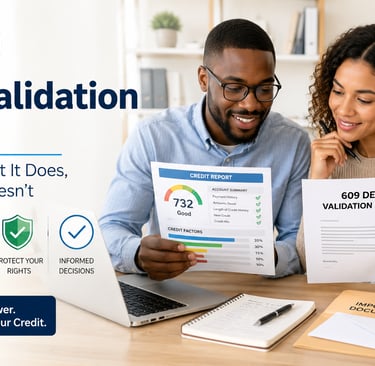
609 Debt Validation Letter — Does It Actually Work?
You may have seen the promises online:
“Send this one letter and the credit bureaus must delete your collections.”
“Demand the original signed contract.”
“If they cannot validate the account within 30 days, it disappears.”
“Section 609 is the credit repair secret the bureaus do not want you to know.”
It sounds amazing, doesn’t it?
One letter. One legal citation. And suddenly, every collection account, charge-off, and late payment disappears from your credit report.
Unfortunately, that is not how Section 609 works.
A properly written 609 letter can help you obtain information from a credit reporting company and identify possible reporting errors. But it is not a magic loophole that forces accurate negative information to be removed.
Even more confusing? The phrase “609 debt validation letter” is technically misleading.
Section 609 deals primarily with information in your credit file. Debt validation rights involving a third-party debt collector generally come from a different law.
Let’s separate the facts from the internet myths so you can understand what a 609 letter can accomplish—and when another type of letter may work better.
Free Resource: Download the free 609 Credit Report Review Letter at the end of this article. It includes practical dispute language without relying on false credit repair claims.
The Quick Answer: Does a 609 Letter Work?
A 609 letter can work when your goal is to:
Request information contained in your credit file.
Learn where reported information came from.
Identify accounts, balances, dates, or personal information that may be incorrect.
Create a written record before or during a credit report dispute.
Ask a credit reporting company to investigate specific inaccurate or incomplete information.
A 609 letter generally will not work when your only argument is:
“Show me the original signed contract or delete the account.”
Section 609 does not create a blanket requirement that a credit bureau produce an original contract bearing your signature before it may report an account.
It also does not require the deletion of information simply because the bureau does not send you every document you requested.
The Fair Credit Reporting Act gives consumers important rights—but those rights work best when you use the correct section of the law for the correct situation.
What Is a 609 Letter?
A 609 letter gets its name from Section 609 of the Fair Credit Reporting Act, which is codified at 15 U.S.C. § 1681g.
Section 609 generally gives you the right to request a disclosure of information in your consumer file, including certain information about its sources and recipients.
In plain English, Section 609 is largely about access and disclosure.
It helps you answer questions such as:
What information does the credit bureau have about me?
Where did that information come from?
Which companies have accessed my credit file?
What account information is currently being reported?
Is my file mixed with another consumer’s information?
That can be extremely valuable.
But requesting disclosure is not the same as proving that an account is inaccurate.
The Important Difference Between Sections 609 and 611
This is where many online credit repair videos and templates get things wrong.
Section 609: Access to Your Credit File
Section 609 generally gives you the right to see information in your credit file and certain related disclosures.
Think of it as saying:
“Show me what you have and where it came from.”
Section 611: Disputing Inaccurate Information
Section 611 of the FCRA, codified at 15 U.S.C. § 1681i, addresses the credit bureau’s duty to conduct a reasonable reinvestigation when a consumer disputes the completeness or accuracy of information in a credit file.
The credit reporting company generally has 30 days to investigate after receiving a dispute, although the period may be extended in certain circumstances.
Think of Section 611 as saying:
“This specific information is inaccurate or incomplete. Please investigate and correct it.”
A strong credit dispute letter may reference both rights:
Section 609 for access to file information.
Section 611 for the investigation of a specific error.
That is much more effective than sending a generic letter filled with legal language but no clear explanation of what is wrong.
Is a 609 Letter Really a Debt Validation Letter?
Not exactly.
The phrase “609 debt validation letter” combines two different consumer rights that are often confused.
Your situationPrimary legal protectionWhat you are requestingYou want information from a credit bureauFCRA Section 609Disclosure of information in your credit fileYou believe your credit report contains an errorFCRA Section 611Investigation and correction of inaccurate or incomplete reportingA third-party debt collector is contacting youFDCPA and Regulation FValidation information and verification of the debt
Debt validation rights involving a debt collector generally arise under the Fair Debt Collection Practices Act, including 15 U.S.C. § 1692g, and its implementing rules.
Collectors must provide certain validation information, including information identifying the creditor and the amount of the debt. Consumers generally receive a 30-day validation period during which they may dispute the debt in writing.
When a written dispute is sent within the validation period, the collector generally must stop collection activity on the disputed debt until it provides verification responsive to the dispute.
That is different from asking Equifax, Experian, or TransUnion for information in your credit file.
Myth No. 1: A Credit Bureau Must Produce the Original Contract
One of the most common 609 letter claims says:
“The credit bureau must provide the original contract with my signature or delete the account.”
That is not what Section 609 says.
A credit reporting company may receive account information electronically from a creditor, lender, servicer, or collection agency. Section 609 gives you important disclosure rights, but it does not generally require the bureau to maintain or produce an original, signed lending agreement for every reported account.
That does not mean you should accept inaccurate information.
It means your dispute should focus on a real reporting problem, such as:
The account does not belong to you.
The balance is incorrect.
The payment history is incorrect.
The account was paid but still shows an unpaid balance.
The account appears more than once.
The date of first delinquency is inaccurate.
The creditor or collector is reporting information belonging to someone else.
The account resulted from identity theft.
The account status is incomplete or misleading.
Specific facts and supporting documents are generally more persuasive than demanding paperwork the credit bureau may not be legally required to possess.
Myth No. 2: Every Account Must Be Deleted After 30 Days
The 30-day investigation period is real—but the internet version of the rule is often exaggerated.
When you properly dispute the accuracy or completeness of an item, a credit reporting company generally must conduct a reasonable reinvestigation within 30 days. The investigation can sometimes be extended by 15 days if you provide additional relevant information during the investigation period.
However, the 30-day rule does not mean:
Every dispute automatically results in deletion.
A minor delay permanently erases a valid debt.
Sending the same generic letter repeatedly forces a deletion.
A credit bureau must respond with an original contract.
An account can never be reinserted after being removed.
The investigation may result in the information being:
Verified as reported.
Updated.
Corrected.
Deleted.
Marked as disputed.
Your outcome depends heavily on the facts, the information being reported, the documents you provide, and the results of the investigation.
Myth No. 3: A 609 Letter Can Remove Accurate Negative Information
A credit reporting dispute is designed to correct information that is inaccurate, incomplete, or unverifiable through a reasonable investigation.
It is not designed to erase information simply because it hurts your credit score.
The Consumer Financial Protection Bureau warns that companies promising to remove accurate negative information may be promoting a credit repair scam. Consumers can dispute genuine inaccuracies themselves at no cost.
For example, imagine that you made a payment 60 days late.
If the creditor accurately reports that late payment, a 609 letter does not automatically make it disappear.
You may have other possible options, such as sending a goodwill letter explaining unusual circumstances, but that is a voluntary request—not a legal dispute asserting that accurate information is false.
Myth No. 4: More Legal Language Makes the Letter Stronger
A five-page letter filled with legal citations, threats, and demands is not necessarily stronger than a one-page letter identifying a clear factual error.
In fact, a vague or repetitive dispute may make it harder for the recipient to understand what you want investigated.
A useful letter should clearly identify:
The company reporting the information.
The account number or partial account number.
The exact information you dispute.
Why that information is wrong or incomplete.
What correction you are requesting.
Which documents support your position.
For example, this is vague:
“This account is invalid. Delete it immediately under Section 609.”
This is more useful:
“The account is reporting a balance of $1,245. My attached settlement confirmation and bank statement show that the agreed settlement payment was received on May 4, 2026. Please investigate the reported balance and update the account to reflect the correct status.”
Specificity gives the investigator something meaningful to review.
Myth No. 5: The Same Letter Should Be Sent to Everyone
The correct recipient depends on the problem.
Send a credit report dispute to the credit bureau when:
The information on your credit report is inaccurate.
An account is not yours.
A balance, date, status, or payment history is wrong.
Your file contains another consumer’s information.
Previously corrected information has reappeared.
The CFPB recommends disputing credit-report inaccuracies with both the credit reporting company and the company that furnished the information.
Send a direct dispute to the furnisher when:
A creditor, lender, servicer, or collector supplied inaccurate information.
You have documents showing the information it reported is wrong.
You want the company to investigate its own records.
Send a debt validation dispute to a collector when:
A third-party collector recently contacted you.
You do not recognize the debt.
You dispute the amount.
You need the name of the original creditor.
You believe the debt was already paid.
You believe the collector contacted the wrong person.
A Section 609 letter sent to a credit bureau and an FDCPA validation request sent to a debt collector serve different purposes.
When Can a 609 Letter Be Helpful?
Despite the myths, a carefully written 609 request can still be useful.
1. When Your Credit File Appears Incomplete
You may want more information about an unfamiliar account, inquiry, address, employer, or name variation.
A file disclosure request can help you understand what the bureau has recorded.
2. When You Suspect a Mixed Credit File
A mixed file occurs when information belonging to another person appears in your credit history.
This can happen when consumers have similar:
Names.
Social Security numbers.
Addresses.
Dates of birth.
Family relationships.
Obtaining your file information can help you identify entries that do not belong to you.
3. When You Are Preparing a Specific Dispute
Before claiming that information is inaccurate, it helps to understand exactly what is being reported.
Your letter can request disclosure while also identifying a specific error for reinvestigation.
4. When You Need a Paper Trail
Written correspondence can document:
When you submitted your request.
Which account you identified.
Which documents you included.
What correction you requested.
How the company responded.
Keep copies of everything you send and receive.
How to Use a 609 Letter Correctly
Here is a more reliable process.
Step 1: Review All Three Credit Reports
Begin with your reports from Equifax, Experian, and TransUnion.
The information may not be identical across all three reports. An account may appear incorrectly on one report while appearing correctly—or not at all—on another.
AnnualCreditReport.com is the federally authorized source for obtaining free credit reports from the three nationwide credit reporting companies. Free online reports are currently available weekly.
Step 2: Circle the Exact Error
Do not simply write, “This account is inaccurate.”
Identify precisely what is wrong:
Ownership.
Account status.
Balance.
Credit limit.
Payment history.
Date opened.
Date closed.
Delinquency date.
Personal information.
Duplicate reporting.
Step 3: Gather Supporting Evidence
Depending on the dispute, supporting documents may include:
Account statements.
Payment confirmations.
Settlement letters.
Cancellation notices.
Court records.
Identity theft reports.
Correspondence from the creditor.
Proof of identity.
Proof of address.
A copy of the credit report with the disputed item marked.
Send copies—not your only originals.
Step 4: Write a Focused Letter
Your letter should explain:
What is being reported.
Why it is inaccurate or incomplete.
What the correct information should be.
What action you want taken.
Which documents support your claim.
Step 5: Track the Investigation
Credit reporting companies generally must investigate disputes within 30 days, subject to certain exceptions and possible extensions.
Save:
A copy of your letter.
Delivery confirmation.
Uploaded documents.
Dispute confirmation numbers.
Investigation results.
Updated credit reports.
Step 6: Review the Results Carefully
Do not look only at whether the item was “deleted” or “verified.”
Check whether the company corrected the exact information you disputed.
When information is verified but you still believe it is wrong, you may consider:
Requesting additional information about the investigation.
Sending a new dispute with material supporting evidence.
Disputing directly with the furnisher.
Adding a brief consumer statement.
Filing a CFPB complaint after completing the required dispute process.
Consulting a consumer law attorney when the error is serious and remains unresolved.
The CFPB generally requires consumers to dispute inaccurate or incomplete information with the credit reporting agency before submitting certain credit-reporting complaints.
What Should You Avoid Putting in a 609 Letter?
Avoid claims such as:
“You must provide a wet-ink signature.”
“Failure to send the original contract proves the debt is invalid.”
“Section 609 requires immediate deletion.”
“You have exactly 30 days or the debt is legally erased.”
“This is not my account,” when you know the account belongs to you.
“I demand deletion,” without identifying an inaccurate fact.
Never submit information you know is false.
A dispute should be based on a good-faith belief that information is inaccurate, incomplete, mixed, duplicated, outdated, or otherwise improperly reported.
Free 609 Letter Template
Want a straightforward template without the fake promises?
Download the Free 609 Credit Report Review and Dispute Letter.
This editable template will help you:
Identify the exact account you are questioning.
Request relevant credit-file information.
Explain what is inaccurate or incomplete.
Reference your disclosure and dispute rights.
List the supporting documents you are including.
Request a written investigation result.
Lead-Magnet Opt-In Copy
Headline: Get the Free 609 Letter Template
Subheadline: Request your credit-file information and dispute specific reporting errors with a clear, editable letter—without relying on internet myths or misleading legal claims.
Button Text: Send Me the Free Template
Privacy Text: We respect your inbox. You will also receive practical consumer-credit tips and may unsubscribe at any time.
The Final Verdict: Does a 609 Debt Validation Letter Work?
A 609 letter is not a secret credit repair loophole.
It cannot guarantee the removal of:
Collections.
Charge-offs.
Late payments.
Repossessions.
Foreclosures.
Other accurate negative information.
But it can be a useful part of your credit review strategy when used for its legitimate purpose.
Section 609 helps you access information in your credit file. Section 611 provides the primary process for disputing inaccurate or incomplete credit-report information. The FDCPA and Regulation F provide separate validation rights when you are dealing with a debt collector.
The difference matters.
Instead of searching for a magic paragraph, focus on the facts:
What information is being reported?
Is it accurate?
Is it complete?
Does it belong to you?
What evidence supports your position?
Which company should receive your letter?
That is how you turn a generic internet template into a meaningful consumer dispute.
Frequently Asked Questions
Will a 609 letter remove a collection?
It may contribute to the removal or correction of a collection if the reported information is inaccurate, incomplete, mixed with another consumer’s information, or cannot be verified through a reasonable investigation.
It does not guarantee removal of an accurately reported collection.
Can a 609 letter remove late payments?
Not merely because the late payments are negative.
When a payment was reported late by mistake, dispute the specific month and provide documents showing that the payment was made on time.
When the late payment is accurate, a goodwill adjustment request may be more appropriate.
Does the credit bureau need my original signed contract?
Section 609 does not generally require a credit reporting company to produce an original signed contract before it may report account information.
Your dispute should focus on whether the information being reported is accurate and complete.
How long does a 609 dispute take?
Credit reporting companies generally have 30 days to investigate a credit-report dispute. The period may be extended by up to 15 additional days in certain circumstances, including when relevant information is submitted during the investigation period.
Should I send a 609 letter to a debt collector?
A credit-file disclosure request is generally directed to a consumer reporting company.
When you are responding to a debt collector, use a debt validation or verification request tailored to the FDCPA and Regulation F.
Can I dispute information myself?
Yes. Consumers have the right to dispute inaccurate credit-report information without paying a credit repair company.
Legal Disclaimer: This article provides general educational information and is not legal advice. Laws, procedures, deadlines, and individual circumstances can differ. Consider consulting a qualified consumer law attorney regarding a specific legal dispute.
Free 609 Credit Report Review and Dispute Letter
Request Your Credit-File Information and Dispute Specific Reporting Errors
This template is designed to help you request information contained in your credit file and dispute a specific inaccurate or incomplete item.
Despite its popular name, this is not a magic credit-deletion letter. It does not guarantee that accurate negative information will be removed.
Before You Send This Letter
Gather the following:
A current copy of the applicable credit report.
The report or confirmation number, when available.
The name of the company reporting the account.
The account number or last four digits.
A clear explanation of the error.
Copies of documents supporting your position.
Proof of your identity and address, when requested by the credit reporting company.
Do not send your only original documents.
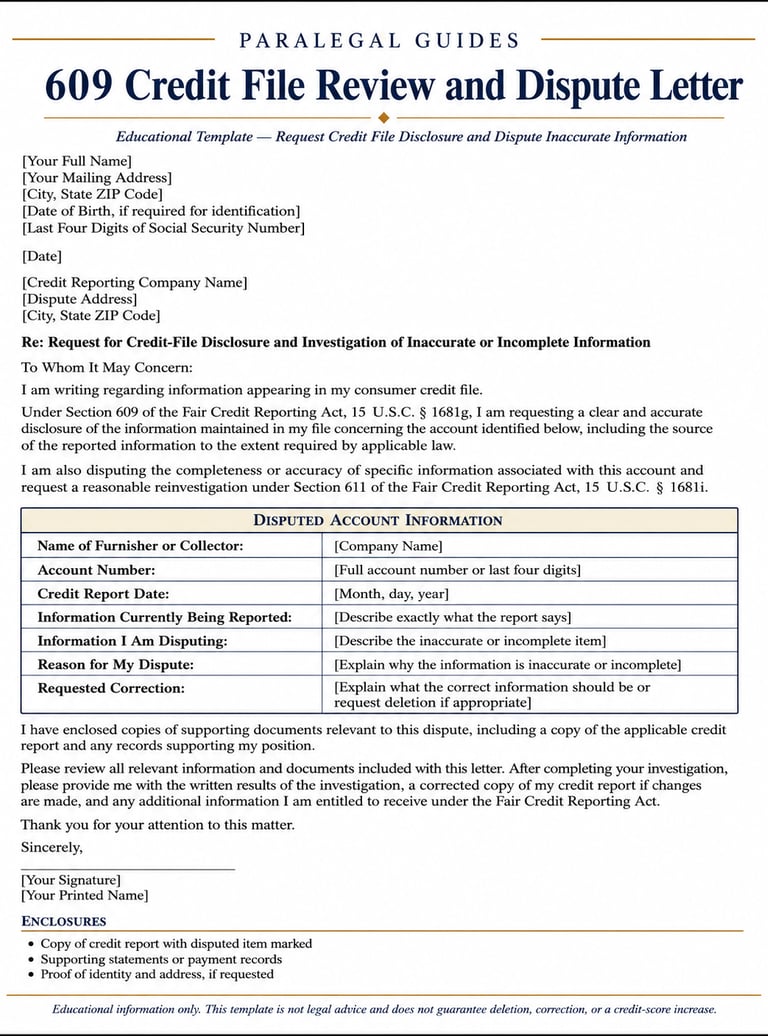
609 Credit File Review and Dispute Letter
[Your Full Name]
[Your Mailing Address]
[City, State ZIP Code]
[Date of Birth, if required for identification]
[Last Four Digits of Social Security Number]
[Date]
[Credit Reporting Company Name]
[Dispute Address]
[City, State ZIP Code]
Re: Request for Credit-File Disclosure and Investigation of Inaccurate or Incomplete Information
To Whom It May Concern:
I am writing regarding information appearing in my consumer credit file.
Under Section 609 of the Fair Credit Reporting Act, 15 U.S.C. § 1681g, I am requesting a clear and accurate disclosure of the information maintained in my file concerning the account identified below, including the source of the reported information to the extent required by applicable law.
I am also disputing the completeness or accuracy of specific information associated with this account and request a reasonable reinvestigation under Section 611 of the Fair Credit Reporting Act, 15 U.S.C. § 1681i.
Disputed Account Information
Name of Furnisher or Collector:
[Company name]
Account Number:
[Full account number or last four digits]
Credit Report Date:
[Month, day, year]
Credit Report Confirmation Number:
[Number, if available]
Information Currently Being Reported:
[Describe exactly what the report says.]
Information I Am Disputing:
[Identify the specific balance, status, date, payment history, ownership information, personal information, or other item that is inaccurate or incomplete.]
Reason for My Dispute:
[Explain clearly why the information is inaccurate or incomplete. Include dates, amounts, and other relevant facts.]
Requested Correction:
[Explain what the information should say or request deletion when the information does not belong to you, is duplicated, or cannot be verified through a reasonable investigation.]
For example:
The account is reporting an outstanding balance of $________. The attached settlement confirmation and payment record show that the agreed payment was received on __________. Please investigate the reported balance and update the account to reflect the correct status.
Or:
I do not recognize this account and have no record of opening or authorizing it. Please investigate whether the account belongs to me and remove it from my file if it cannot be verified as mine.
Or:
The payment history reports a late payment for __________. The attached account statement and bank record show that the payment was received on __________, before the due date. Please correct the payment history.
Documents Included
I have enclosed copies of the following documents in support of my request:
[Copy of credit report with disputed item marked]
[Account statement]
[Payment confirmation]
[Settlement letter]
[Cancellation notice]
[Identity theft report]
[Proof of identity]
[Proof of address]
[Other supporting document]
Please review all relevant information and documents included with this letter.
After completing your investigation, please provide me with:
Written results of the investigation.
A corrected copy of my credit report if changes are made.
Identification of any information that was updated or deleted.
The name and contact information of the source that verified the disputed information, to the extent required by applicable law.
Any additional information regarding the disputed account that I am entitled to receive under the Fair Credit Reporting Act.
This letter is a good-faith request for disclosure and investigation of specific information. I am not requesting the removal of accurate information merely because it is unfavorable.
Thank you for your attention to this matter.
Sincerely,
[Your Signature]
[Your Printed Name]
Enclosures
[List every enclosed document]
[Do not send original documents]
Mailing Checklist
☐ I reviewed the correct credit report.
☐ I identified a specific error.
☐ I explained why the information is inaccurate or incomplete.
☐ I stated the correction I am requesting.
☐ I included copies of supporting documents.
☐ I included identification documents requested by the bureau.
☐ I kept a complete copy of the letter and enclosures.
☐ I saved proof of mailing or electronic submission.
☐ I recorded the date the dispute was received.
☐ I will review the investigation results carefully.
Which Letter Should You Use?
Use this 609 credit-file letter when:
You need information maintained by a credit reporting company.
You are questioning information appearing on a credit report.
You are disputing a specific credit-report error.
Use a debt validation letter when:
A third-party debt collector has contacted you.
You dispute the debt or the amount.
You want information identifying the creditor and debt.
You are responding during the collector’s validation period.
Use a goodwill letter when:
The negative information is accurate.
You experienced unusual circumstances.
You are asking a creditor to make a voluntary adjustment.
Educational Disclaimer: This template provides general educational information and is not legal advice. It does not guarantee deletion, a credit-score increase, or any particular outcome. Modify the letter to reflect truthful facts and your individual circumstances.
Address
Alexandria Virginia 22304
United States of America
Contact
paralegalguides100@gmail.com
Subscribe to our newsletter
Paralegal Guides ™
Disclaimer: This website and product are for educational and informational purposes only. Nothing on this page is legal advice, financial advice, credit counseling, or a guarantee of any credit outcome. This product does not promise to remove accurate information from credit reports or guarantee credit score increases. Consumers should review their own circumstances and consult a qualified professional when needed.
© 2026. Paralegal Guides ™ | A Paralegals Guide to Credit Repair ™All rights reserved. Storks Enterprise LLC Privacy Policy | Cookie Policy
Social Media
Paralegal Guides
Plain-English, do-it-yourself legal guides and templates. By Charles, a working paralegal.